
Efficient and Sustainable Waste Water Treatment Solution
Article written by Sean Renwick, Site Engineer at GridLine Property Developments
The modern world has seen the development of many new and innovative technologies aimed at reducing the negative impacts humans have on the environment. We at Gridline are passionate about the environment and are always seeking new ways to become more environmentally friendly while ensuring our tenants and home owners live efficiently and stress free. Often these solutions towards sustainable environmental development come at a cost. A feasibility study was conducted into installing a greywater treatment system for our new development and conclude whether the installation was justified by the reduced municipal costs and value to the environment.
Greywater is a form of wastewater without any faecal matter which is commonly discharged from sinks, showers, basins and appliances. (Grey Water Action) Blackwater on the other hand contains faecal matter. Both can be treated and reused for the flushing of toilets, irrigation and other non-potable uses. In addition, greywater is usually more beneficial to garden plants than tap water as it contains many residual chemicals found in soaps which provide nutrients for plant growth. (Green)
A particular treatment tank, supplied by Maskam Water, was analysed which has the potential to produce up to 5 000 litres of treated greywater per day, depending on the quantity of influent. (Maskam Water) Effluent water from the sources mentioned above enters a single tank with three different chambers each playing their respective role in the treatment process. Solids are removed through filtration and sedimentation together with fats before activated sludge treatment begins. Activated sludge treatment is a type of wastewater treatment which uses multiple chambers to treat wastewater by using micro-organisms which break down waste in the presence of oxygen. (TUSER, 2021) Harmful by-products from the reaction, such as nitrogen gas, are diffused into the atmosphere. Finally, treated effluent is disinfected using ultraviolet light and stored in tanks readily available. The system is easy to install, odourless and requires minimal maintenance of 1 hour every 6 months. This is because there are no moving parts besides the impellers in the booster pumps. Desludging is required every 4-6 years. (Maskam Water)

There are multiple different products on the market each specifically designed based on the demand for greywater and the quantity of wastewater produced by a development or building. A model was computed based on our newly established development 5 on Westminster (see our webpage for more information) in order to determine the feasibility of installing a greywater treatment system. The system would be installed to communally treat wastewater for all four units. The treatment tank, which can be found in the figure above, will be installed below ground effectively optimising space and maintaining the aesthetic value of this development. A number of assumptions were made in order to determine the quantity of water produced since the project is still within the planning phase. This was then compared to the amount of greywater which could be re-used for irrigation and the flushing of toilets. A particular treatment tank, supplied by Maskam Water, was analysed which has the potential to produce up to 5 000 litres of treated greywater per day. (Maskam Water)
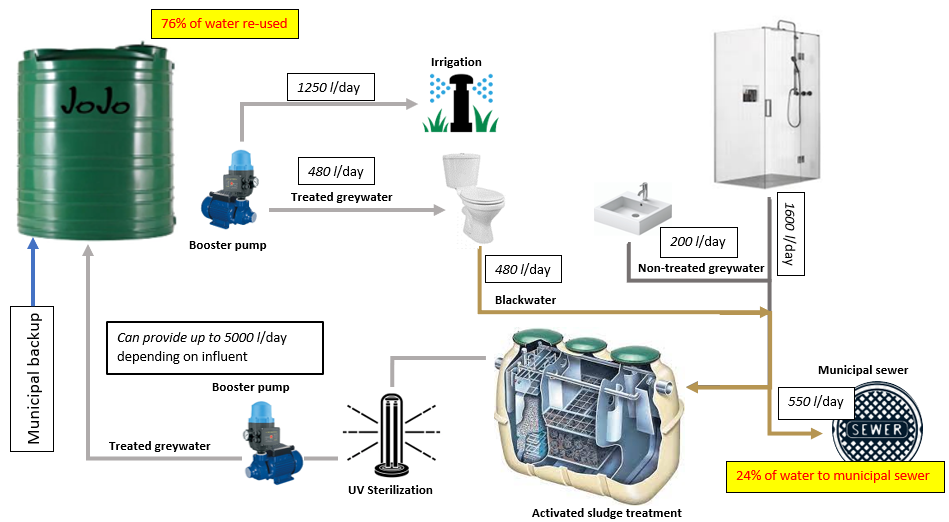
The schematic above clearly highlights the benefits of installing the greywater treatment system in question with 76% of wastewater produced by the cluster development being re-used. That’s a saving of approximately R9 000-00 per unit per year which would have been spent on municipal water. Since more wastewater was produced by showers, toilets and basins than what was re-used for the flushing of toilets and for irrigation, a certain proportion of this water would need to be discharged under gravitational flow to the municipal sewer. As previously mentioned, the system has the capacity to produce up to 5 000 litres of greywater per day. This implies that should additional greywater be required for other non-drinking purposes such as the washing of cars, the system has the capacity to.
There are multiple benefits of installing this greywater system to home owners, municipalities and the environment. Home owners will be able to use water for non-potable purposes when there is a lack of municipal water. Owners will also require less water from the municipality thereby saving costs and effectively reducing the burden placed on ageing municipal infrastructure since there is less demand for municipal water and less waste discharged to the municipal sewer. As developers we often experience delays with council approvals and incorrectly billed properties. A greywater system would dramatically reduce the potential for these delays or errors as there is less demand placed on the municipal water and sewer network thereby making development approvals more seamless.
The initial capital cost to supply and install the system is R110 000-00 per unit. Although this initial cost is significant, operational costs are minimal. It should take approximately 12 years to justify this initial cost. However, there are additional benefits which have not been given a monetary value and considered in this evaluation such as the reduced impact on the environment. The shift in global trends towards innovative green technologies suggests that it is certainly a good investment.
The climate is changing and so should we.